“Flirting with the Help”
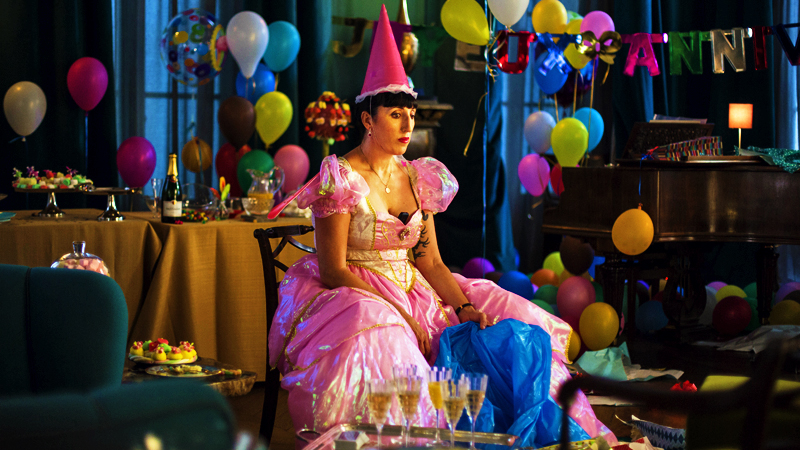
When Toni Collette’s Anne is unpleasantly surprised by the arrival of her stepson Steven (Tom Hughes) on the night of her social-climbing dinner party, her decision to involve her Spanish housekeeper Maria (Rossy de Palma) in an effort to maintain aesthetics, proves to be a farcical nightmare.
Fine, I’ll admit it. Nobody else will: being an actor and being in love can be kind of a mind-fuck. It seems like the most obvious conclusion to draw about a group of people who are essentially paid to lie, but it’s hardly ever openly talked about in acting circles actually. I’m talking specifically about Method Actors here. Models and Soap Opera stars can hit the bench for this one. As Method Actors, our brains have to handle at least 3 forms of consciousness at once: 1) The consciousness of who you are as a person 2) The consciousness of your training as an actor and 3) The consciousness of your character. Keeping those lines well-defined is like doing never-ending emotional contortions. It’s only in the candle-lit bedrooms of my actor friends — during mental cleansing ceremonies at the altar of St. Celine — where we even dare to hint at topics like this. It’s a scary thing to admit out-loud that you may be living a contrived existence off-camera. When your life is a constant alternate reality game, the boundaries can get blurred quite easily.
I’ve had those moments of existential panic, where I’ve doubted if I really liked someone, or if it was just research for a scene. To civilians, it might sound too abstract, but Method Acting is about using your body to express the character. Part of the fuel that moves your body is emotions, and those emotions have to have a true source. That true source is somewhere inside of you and it’s your job to find it. Without it, you’re not acting, you’re phoning it in. Method actors are known to re-create/encourage the circumstance surrounding their character’s motivations in real life. If I’m playing a love-sick romantic role, of course I’m gonna go around seducing civilians so I can induce oxytocin in my brain. I’m reverse engineering the Sense Memory Technique. It just helps us form a better connection with the material — ask Jared Leto. Actually…maybe don’t ask him. In acting class, nobody ever explicitly tells you to go around and con civilians, but its implied. Just like they tell writers to write the truth, they tell us actors to use our own experiences in fleshing out a character. Well, what if you don’t have any of your own experiences? You’re going to have to create them, at the expense of regular folk, I guess.
The film Madame, was a cruel exploration of this very scenario creative people find themselves in: the question of exploitation vs. exploration. It has been said that art is mirror to society and that by seeing ourselves represented in art, we can have some form of catharsis. It is for this reason that the exploration of cultural themes is encouraged through art. While we can explore these themes using our imagination or observation, when does it become exploitation? Is it ever justified to engineer painful situations in order to reverse engineer art? We live in a capitalist society where artists have to commoditize their work if they want to survive. You have to be a consistent producer in this world, so the artistic ends justify the means, right? I’m not sure how I feel about that idea; and the film itself doesn’t try to make a concrete statement either way. All I came away with at the end of Madame, is that true romance is for the poor. I also learned that blue collars and silk collars don’t mix — in the wash and in social circles.
The plot centres on the exploitation of Maria (Rossy de Palma), the housekeeper, by Steven (Tom Hughes) a trust-fund-baby a lush a writer, who needs to turn in a manuscript to his publisher for his sophomore book. With a looming deadline and running as dry on ideas as the dry gin he’s fond of, he reverse engineers inspiration. Steven orchestrates a romance between Maria and one of his step-mother’s hoity-toity dinner guests. The story follows the unravelling of this farce— all for his entertainment and documentation. Rossy de Palma is marvellous in this role. She brings a deep European aesthetic and tone with her performance, which intentionally clashes with the American ideals Toni Collette’s Anne Fredericks forces on her (and us) throughout the film. Admittedly, I had been captivated by de Palma when I went through my Spanish cinema phase when I was in high school, so I was pleasantly surprised to see her as an adult still being amazing. Her performance shines alongside acting legends Toni Collette and Harvey Keitel — who plays Bob Fredericks. Her pure, unadulterated innocence elevated her role in this film to iconic status. Iconic among us regular poor folks, that is.
On one hand, the film is an ironic work of art. It’s scathing commentary on the elite class while also reinforcing their power and dominance is where the comedy comes from. On the other hand, it’s actually a critique of its audience. I mean, if we look in the mirror and squint really hard, the film reveals a lot about ourselves. It’s easy to say how politically incorrect the whole affair is, but in reality we’re all just like Anne Fredericks. In The Late Flight Show vlog episode Flirting with the Help, I talk about elitism on film sets. It’s true, film sets have a hierarchal structure second only to the British Royal Family. Even the CIA is more welcoming to new comers. The vlog episode is playing in the background as I write this, and listening to it, it sounds as bonkers as what’s revealed in this movie — that in the 21st Century, the only “-ism” we’re allowed to overtly practice is classism.
Had I seen this film using only my civilian brain, I might not have enjoyed it as much as I did.This film asks the average viewer to dig just a little bit deeper than usual. It’s a deceptively simple ask because of all the surface action going on, but beneath Anne’s lustful stares at Antoine’s delicious dad-bod in boxer-briefs lies the revealing story of desperate white people. I think Madame represents the audience it was targeting, which is a risky thing to do as a film producer with this kind of material. Most audience members don’t want to see the truth of who they are. They’d rather escape who they are for 90 minutes or; they’d rather watch a film which confirms their pre-conceived ideas about who other people are for 90 minutes. Madame is not a Hollywood film, so I wouldn’t go in to watch it with Hollywood expectations. It’s even referenced in the film during the inciting incident at the dinner party — how Hollywood films are unrealistic trash for the masses. Okay, they don’t say it quite like that, but that’s definitely the tone. You know how rich people talk. Don’t look at me, I don’t know nothin’ about nothin! I’m just a stoned beach boy from a little town called Umhlanga Rocks minding my own business.
See You Next Wednesday,
Charlie
#methodacting #princealbert #richpeople
review
TL;DR
8/10
After watching Madame, I immediately gave it a 6/10 to punish it for delivering what it repeatedly told me it would deliver: a non-Hollywood narrative. That’s when I changed my rating to an 8. Well…That…and my zaddy Stanislas Merhar (Dry Cleaning) teases dong in it so I had to bump it up to an A-. It’s a European film that’s done in English, and it may be jarring for people who are not used to European cinema.
$
BB – Big Budget – $20mil+
SB- Small Budget – $5mil+
LB – Low Budget – $1 mil+
MB – Micro Budget – $250K+
NB – No Budget – <$50K
*
Rossy de Palma, Toni Collette, Harvey Keitel, Tom Hughes, Michael Smiley, Stanislas Merhar, Joséphine de La Baume, Sonia Rolland, Brendan Patricks, Tim Fellingham
?
The cast in this film work well together and they made it easy for me to be absorbed into their vapid world. Rossy de Palma gives a very innocent expression to her character Maria. I could feel her earnest yearning through the screen, while Toni Collette’s Anne intentionally gave me flashbacks of every white person who’s told me I “speak well”.
Charlie can be seen taking flights and acting like a thespian on Scribblebytes’ The Late Flight Show on YouTube. Click here to subscribe.
Related episode: Flirting with the Help

 The Late Flight Movie Blog